HSK Vocabulary List (All Levels): Word Counts & How to Learn Them
Exactly how many words each HSK level requires, how the counts changed under the new HSK 3.0 standard, and the fastest way to actually memorize them — with audio and example sentences.
The HSK vocabulary list runs from about 300 words at HSK 1 up to roughly 11,000 words in total across the new HSK 3.0 advanced bands (7–9), according to the official exam syllabus (考试大纲) published by the test operator, Chinese Testing International. The cumulative targets are: Band 1 — 300 words, Band 2 — 500, Band 3 — 1,000, Band 4 — 2,000, Band 5 — 3,600, and Band 6 — 5,400, with Bands 7–9 tested as one combined advanced exam covering about 11,092 words. Under the older HSK 2.0 system the counts were lower: HSK 1 required just 150 words and HSK 6 topped out at 5,000. The most effective way to learn any level's list is spaced-repetition flashcards paired with audio and example sentences, not a static PDF you never open.
Vocabulary is the backbone of every HSK section — listening, reading, writing, and (under HSK 3.0) speaking all depend on it. The official lists are graded by frequency, so learning them in order means you pick up the most useful words first. Below is the full per-level breakdown for both the current and new standards, plus how to memorize them without burning out.
How many words are in each HSK level?
China is transitioning from the 6-level HSK 2.0 system to the new 9-level HSK 3.0 standard, which roughly doubles the vocabulary at most levels. Both are relevant in 2026 — HSK 2.0 is still offered during the transition — so here are the cumulative word counts side by side:
| Level | HSK 2.0 (current) | HSK 3.0 (new) |
|---|---|---|
| Level / Band 1 | 150 | 300 |
| Level / Band 2 | 300 | 500 |
| Level / Band 3 | 600 | 1,000 |
| Level / Band 4 | 1,200 | 2,000 |
| Level / Band 5 | 2,500 | 3,600 |
| Level / Band 6 | 5,000 | 5,400 |
| Bands 7–9 (new) | — | ~11,000 total |
Counts are cumulative (each level includes the words below it) and follow the official HSK 3.0 exam syllabus (考试大纲) from chinesetest.cn. The advanced bands 7–9 share one combined vocabulary set that brings the grand total to roughly 11,000 words. For what else changed, see our HSK 3.0 guide.
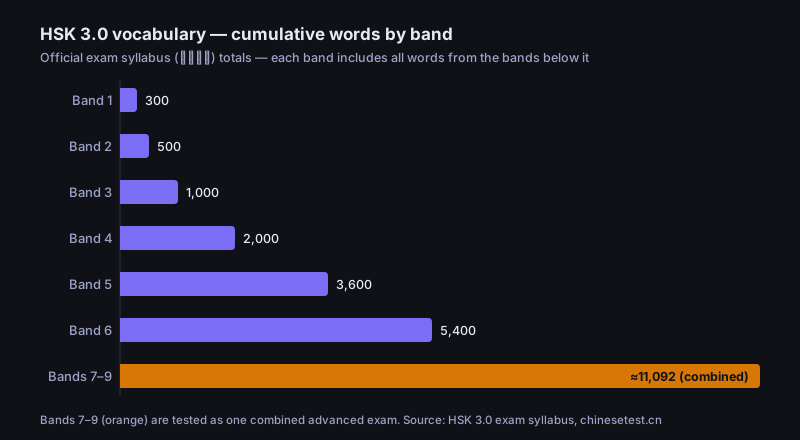
HSK 2.0 vs HSK 3.0 vocabulary — what changed
The headline change is size: HSK 3.0 nearly doubles the vocabulary at the lower levels (HSK 1 jumps from 150 to 300 words) and adds three advanced bands on top. But it's not only more words — HSK 3.0 also grades vocabulary together with grammar and syllables into a single graded standard, and it introduces a mandatory speaking component from Band 3, which means you need to actively produce more of your vocabulary, not just recognize it.
HSK vocabulary by level
HSK 1–2 (beginner: ~300–500 words)
High-frequency essentials: pronouns, numbers, dates, family, food, and simple present-tense sentences. This is where you build the pinyin-and-tone habits everything else rests on. Learn each word as sound + tone + character, not just its shape.
HSK 3–4 (intermediate: ~1,000–2,000 words)
The conversational range. HSK 4 in particular is the level most employers and universities ask for, so its list is worth over-learning. Thematic grouping (travel, work, emotions) helps far more than alphabetical drilling here.
HSK 5–6 & Bands 7–9 (advanced: ~3,600–11,000 words)
Abstract and formal vocabulary for reading articles, following the news, and writing. At this scale, wide reading and listening do more than flashcards alone — you meet words in context often enough to retain them naturally.
Study the list with audio and example sentences
A static word list you download and never open won't move your Chinese forward. What works is meeting each word repeatedly, in context, with sound. Inside HSK University you can browse every level's official vocabulary with audio for every word and example sentences that show real usage, then drill them with spaced-repetition flashcards — all free. That's a more effective (and more current) reference than a PDF, because the list stays aligned with the official HSK 3.0 standard.
How to actually memorize HSK vocabulary
- Use spaced repetition (SRS). Reviews scheduled just before you'd forget are the single most efficient way to move words into long-term memory.
- Learn words, not characters in isolation. Tie each word to its sound, tone, and an example sentence so you can actually use it.
- Group by theme. Studying related words together (all the food words, all the travel words) builds stronger, more retrievable connections.
- Meet words in context. Reading and listening at your level reinforces flashcard work and teaches usage a list can't.
- Test before you advance. A quick practice test confirms a level's words have stuck before you pile the next level on top.
Why trust these numbers
This reference is maintained by the team behind HSK University, a learning platform used by more than 1 million learners in 4 months worldwide and built entirely around the official HSK curriculum, including the new HSK 3.0 standard. Word counts follow the official HSK 3.0 exam syllabus.
- Every level's official vocabulary with audio and example sentences
- Spaced-repetition flashcards to memorize them efficiently
- Full HSK mock exams to confirm what's stuck
- Available in English, German, Russian, Spanish, and Burmese
Frequently asked questions
-
How many words do you need for HSK 4?
Under the current HSK 2.0 system, HSK 4 requires about 1,200 cumulative words. Under the new HSK 3.0 standard, Band 4 rises to about 2,000. HSK 4 is the level most jobs and universities ask for, so it's worth over-learning.
-
How many words are in HSK 3.0 in total?
Roughly 11,000 words across all nine HSK 3.0 levels, with the advanced bands 7–9 sharing one combined vocabulary set. The lower bands are cumulative: 300 (Band 1), 500, 1,000, 2,000, 3,600, and 5,400 (Band 6).
-
Is there a free HSK vocabulary PDF?
You can study every level's full official list for free inside HSK University, with audio, example sentences, and spaced-repetition flashcards. That stays aligned with the official HSK 3.0 standard, which a one-off PDF quickly won't.
-
What's the fastest way to memorize HSK vocabulary?
Spaced-repetition flashcards paired with audio and example sentences, reviewed daily. Learn words in context and grouped by theme rather than drilling isolated characters, and test yourself before moving up a level.
-
Did HSK 3.0 change the vocabulary lists?
Yes — HSK 3.0 nearly doubles the vocabulary at most levels (HSK 1 went from 150 to 300 words) and adds three advanced bands (7–9). If you studied for HSK 2.0, the words you knew still count, but each level now expects more.
Learn the HSK Vocabulary — Free
Every level's official word list with audio, example sentences, and spaced-repetition flashcards. Study them and test yourself, all in one free account.
Start Free →