Is HSK Worth It? An Honest Answer for 2026
Straight answer, no marketing spin: HSK is worth it for some people and a waste of time for others. Here's how to tell which one you are.
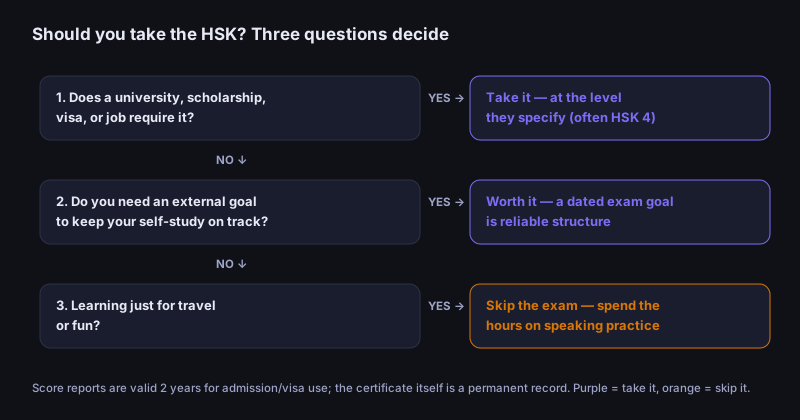
HSK is worth it if you need proof of Chinese ability for a university, visa, scholarship, or job — but it does not guarantee real-world fluency, and if you're learning Chinese purely for travel or fun, you probably don't need the exam at all. The HSK is the official standardized Mandarin test administered worldwide by Chinese Testing International; the level most institutions ask for is HSK 4, score reports stay valid for 2 years for admission and visa purposes, and the certificate itself remains a permanent record of what you achieved. The decision comes down to three questions: does someone require it, do you need an external goal to keep your study on track, or is it just for fun? If it's required — take it at the level they specify. If you need structure — it's worth it for that alone. If it's purely for fun — skip the exam and spend those hours on speaking and listening practice instead. Below is who really needs it, what it proves, and the honest downsides.
The short answer: yes, if…
HSK is clearly worth it if any of these apply to you:
- You're applying to a Chinese university or a Chinese-taught degree program.
- You're pursuing a scholarship (such as the CSC / Chinese Government Scholarship).
- You need it for a work visa, job, or promotion where Chinese proficiency is required or rewarded.
- You want an external goal and structure to stop your self-study from drifting.
If none of those apply and you just want to chat on a trip to China, a certificate won't add much — your time is better spent on speaking and listening practice than on exam prep.
What HSK proves — and what it doesn't
HSK is the official standardized test of Mandarin proficiency, recognized by universities, governments, and employers worldwide. A certificate is credible, portable proof that you've reached a defined level of reading and listening (and, under the new HSK 3.0, speaking).
What it doesn't prove is fluency. Historically the HSK focused heavily on reading and listening, so it's possible to pass a level and still struggle to hold a natural conversation — which is exactly why HSK 3.0 is adding a mandatory speaking component. Treat the certificate as a milestone that opens doors, not as a finish line that means you "speak Chinese."
Who actually needs HSK — and which level
| If your goal is… | The level usually asked for |
|---|---|
| Chinese-taught university degree | HSK 4, often HSK 5 for competitive programs |
| Government scholarship (e.g. CSC) | HSK 4–5, higher for top programs |
| A job that values Chinese | HSK 4 is a common minimum; HSK 5–6 stands out |
| Proving progress to yourself | Whatever your current level — the goal is the structure |
| Casual travel or hobby learning | None — you don't need the exam |
Requirements vary by institution and change over time — always confirm the exact level with the specific university, scholarship, or employer you're targeting.
Does HSK 3.0 change the answer?
Yes, in a way that mostly makes HSK more worth it. The new 9-level HSK 3.0 system adds a mandatory speaking component from Band 3 and expands the advanced levels, which makes the certificate a more complete signal of ability than the old reading-and-listening-heavy exam. It also means the certificate you earn now is aligned with the standard institutions are moving toward. If you're deciding between the old and new exams during the 2026 transition, our HSK 3.0 guide explains which one to register for.
The honest downsides
Worth it for…
- Concrete, recognized proof for study, visa, or work
- A clear goal that keeps self-study on track
- A structured, frequency-graded path through the language
- A globally accepted benchmark you can put on a CV
Not worth it if…
- You only want casual conversational Chinese
- You'd mistake passing for genuine fluency
- You'd grind vocabulary lists but never actually speak
- Your target institution doesn't require it
A few honest caveats: your score report is officially valid for only 2 years for admission and visa purposes (the certificate itself is a permanent record), so timing it close to when you need it matters; exam prep can pull you toward test-taking skills over practical speaking if you're not careful; and the exam has a fee, so it's worth being sure you actually need it before booking — see how much the HSK exam costs.
How to decide — a 3-question test
-
Does someone require it?
If a university, scholarship, visa, or employer asks for an HSK level — the decision is made. Take it, at the level they specify.
-
Do you need external structure?
If your self-study keeps stalling, a dated exam goal is one of the most reliable ways to stay consistent. That alone can make it worth it.
-
Is it just for fun or travel?
Then skip the exam. Put the same hours into speaking, listening, and real conversation instead — you'll get more out of them.
If you decide it's worth it
The good news: you can prepare for HSK entirely for free. HSK University is used by more than 1 million learners in 4 months, across 186 countries, with a full curriculum, official vocabulary, and real mock exams at no cost. Find your level with a free HSK practice test, or start from the beginning with our free Chinese roadmap.
Why trust this answer
This guide is maintained by the team behind HSK University, a learning platform used by more than 1 million learners in 4 months, across 186 countries and built entirely around the official HSK curriculum, including the new HSK 3.0 standard. We give an honest answer — including "don't take it" when that's the right call — rather than pushing everyone toward the exam.
- Complete HSK 1–5 lessons with official vocabulary lists
- Full-length HSK mock exams in the real test format
- SRS flashcards, native-audio listening practice, and an AI tutor
- Available in English, German, Russian, Spanish, and Burmese
Frequently asked questions
-
Is HSK worth it for getting a job?
If the job values or requires Chinese, yes — HSK 4 is a common minimum and HSK 5–6 makes you stand out. It's recognized proof employers understand. For a job with no Chinese requirement, it adds little.
-
Does HSK expire?
Your score report is valid for 2 years from the test date for university admission and visa purposes, so if an institution needs a current result, take (or retake) the exam close to when you'll submit it. The certificate itself doesn't expire — it remains a permanent record of the level you achieved.
-
Is HSK recognized internationally?
Yes — HSK is the official international standard for Mandarin proficiency, recognized by universities, governments, and employers worldwide. That recognition is a big part of what makes the certificate worth having.
-
Does passing HSK mean I'm fluent?
No. HSK proves you've reached a defined level of reading, listening, and (under HSK 3.0) speaking — but you can pass a level and still find real conversation hard. Treat it as a milestone, not proof of fluency.
-
Which HSK level should I aim for?
Aim for the level your goal requires — commonly HSK 4 for universities and jobs, HSK 5–6 for competitive programs. If you're studying for yourself, pick the next level up from where you are now and build from there.
Prepare for HSK — Free
If HSK is worth it for you, you don't need to pay to prepare. Full curriculum, official vocabulary, and real mock exams — free.
Start Free →